Growth · weekly update

A radar, a repricing, and two flows you can click

Week of August 17 to 21, 2026

Carlos McCoy · Growth
Week of August 17 to 21

The week at a glance

Now running
RFP Radar watches 16 public procurement sources every weekday and drafts responses from a verified claim library. The price-increase pilot reached 9 acceptances from 40 accounts, zero declines.
Ready to review
Default services repriced against market data and published to a review site for David. 55 of 108 prices revised, structure untouched.
Prototypes to click
The Learning Centre rebuilt academy-style, and an NPI lookup inside signup that seeds a new workspace with real practice data. Both live as clickable prototypes.

The thread this week: stop describing ideas and put working versions in front of people. Every project on the next slides has a URL you can open.

A radar for public contracts we could win

Finds and scores, every weekday

Live

16 free sources (SAM.gov, state portals, UK, Canada) are swept each morning. Candidates are scored against a fit rubric built from what we can actually deliver. First run scored 170 opportunities: 0 pursue, 7 review, 163 skip. An empty pursue list is a true result, not a failure.

Drafts answers that never overstate

A library of 211 verified capability claims, 103 taken verbatim from Glen's past responses. Test: we regenerated a real RFI from raw questions and matched Glen's answers 33 of 33, including his three hard nos. Anything unverified renders as a question for Glen, never a guess.

What the segment looks like

Estimate: 8 to 14 relevant opportunities a month at current coverage, 1 to 3 worth bidding. Best near-miss so far: a SUNY campus health EHR at $50,000 to $125,000 that closed two days after we found it. Registrations on the two best US portals come next.
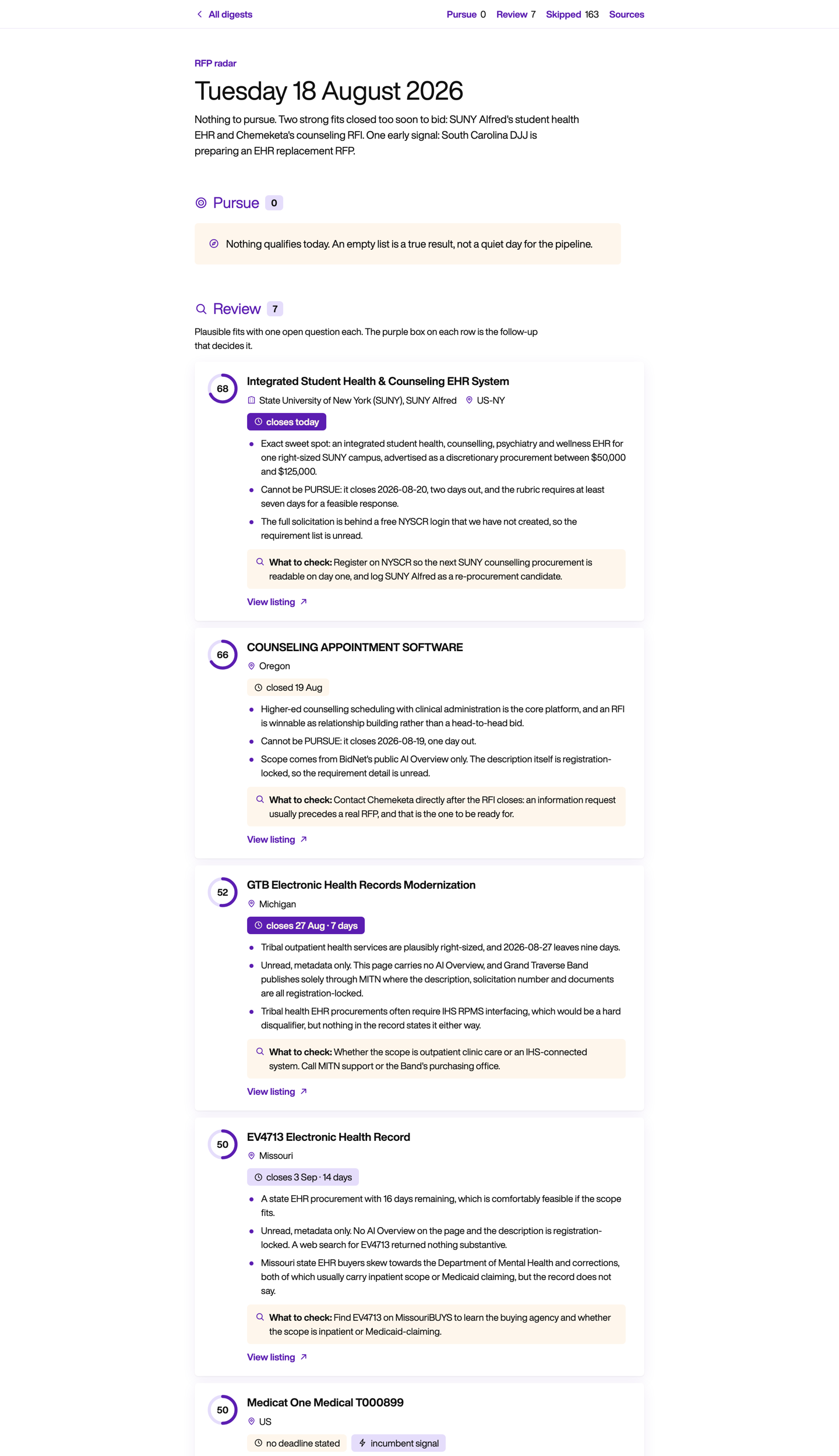
RFP Radar daily digest with scored opportunities
The daily digest · scroll for the scored cards · Telegram ping when anything hits pursue
learn.carepatron.com · 1 of 3

The Learning Centre reads like a document site

Thin reach, flat content

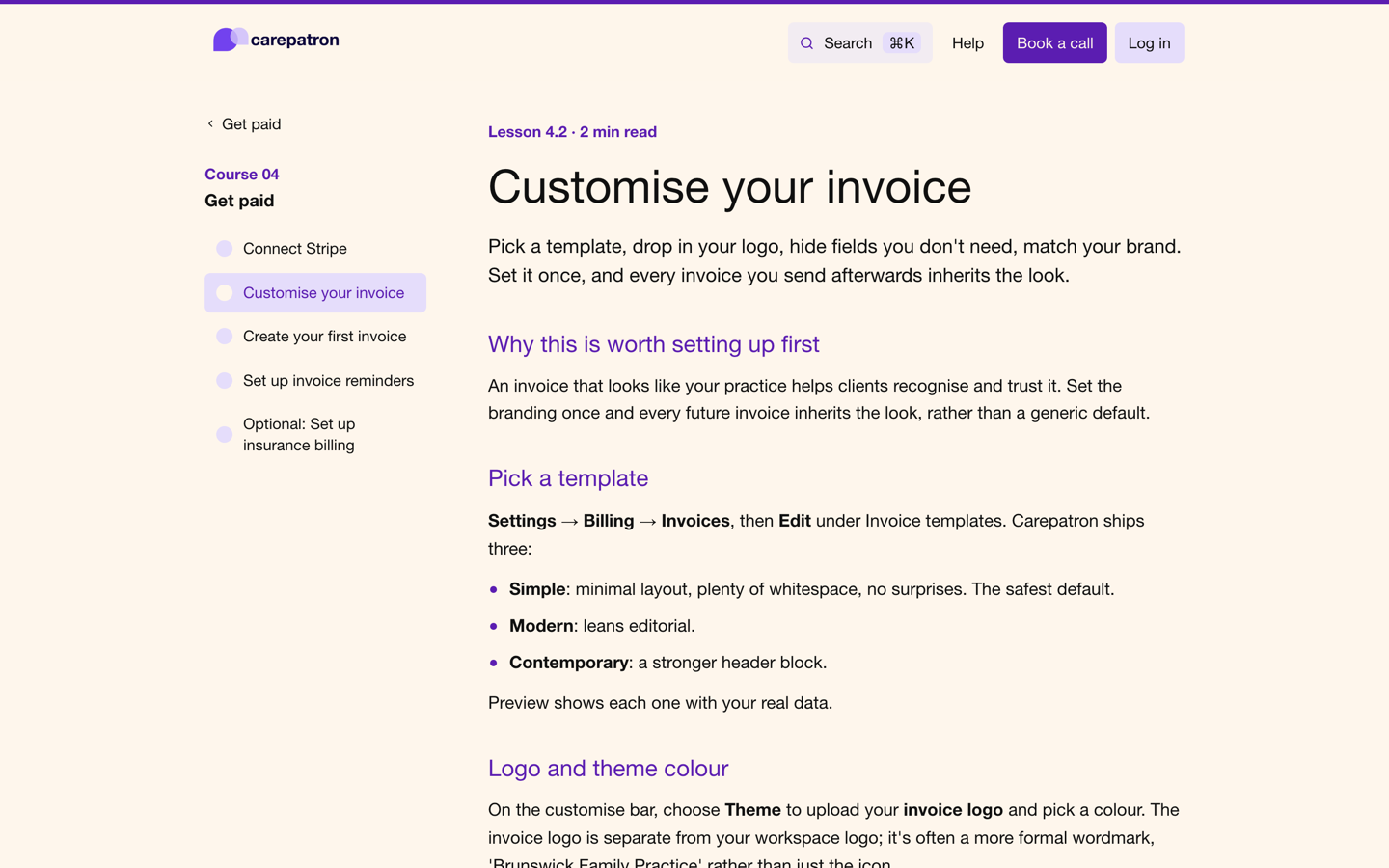
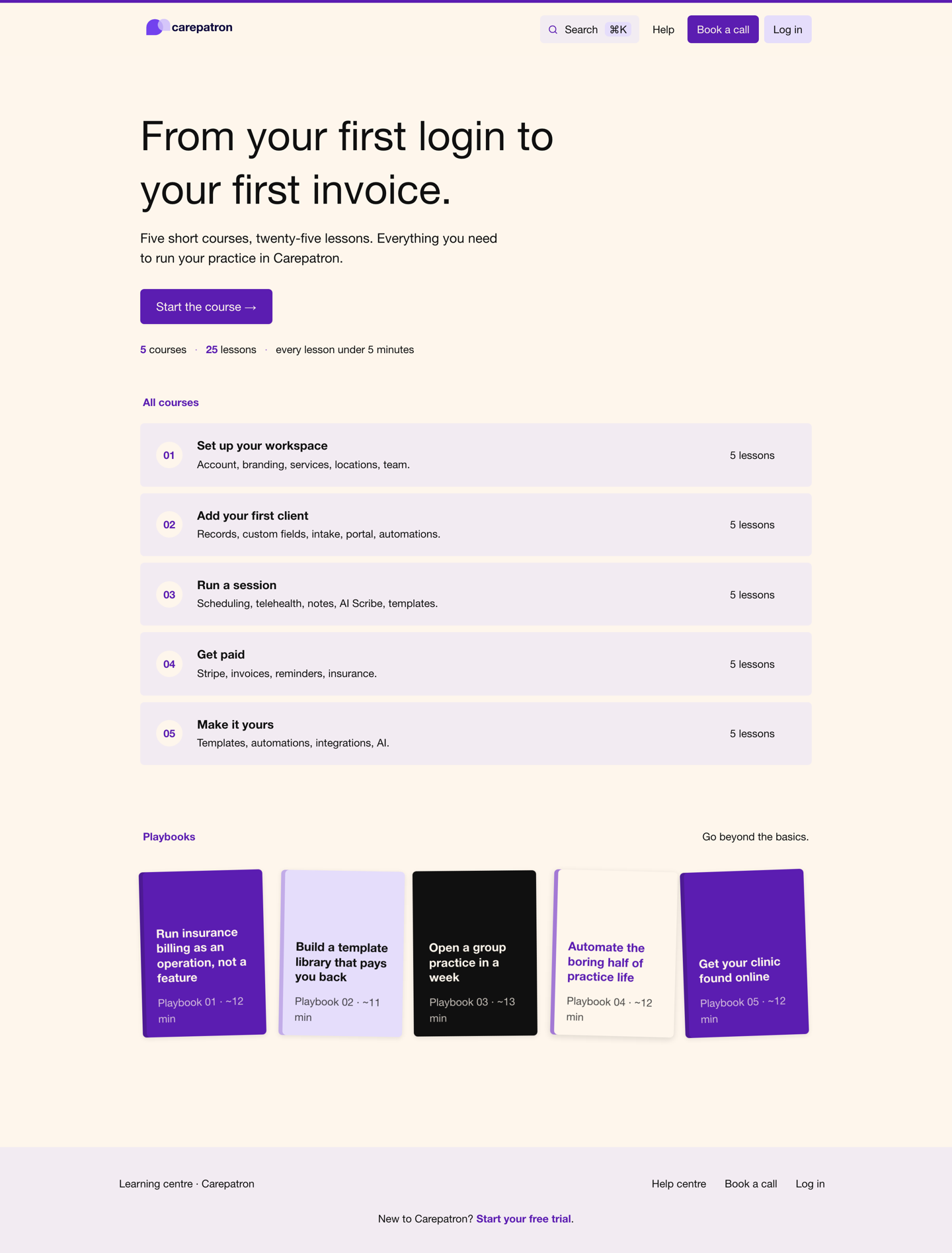
5 courses, 25 lessons, 5 playbooks, untouched since 9 July. The setup-dashboard link has drawn 175 clicks in its whole life, about 7 to 8% of people who click anything on that dashboard. Lessons are long prose with no way to check you did the thing.

The first redesign pass failed

An additive pass (paths, quizzes, checklists layered on top) made it busier, not better, and was rejected on sight. At 25 lessons, extra navigation just buries the content. That failure shaped everything after it.

Current learn.carepatron.com home
Today's home · scroll to see the full page
Current lesson page
Today's lesson page
learn.carepatron.com · 2 of 3

So the redesign became a set of decisions, not a build

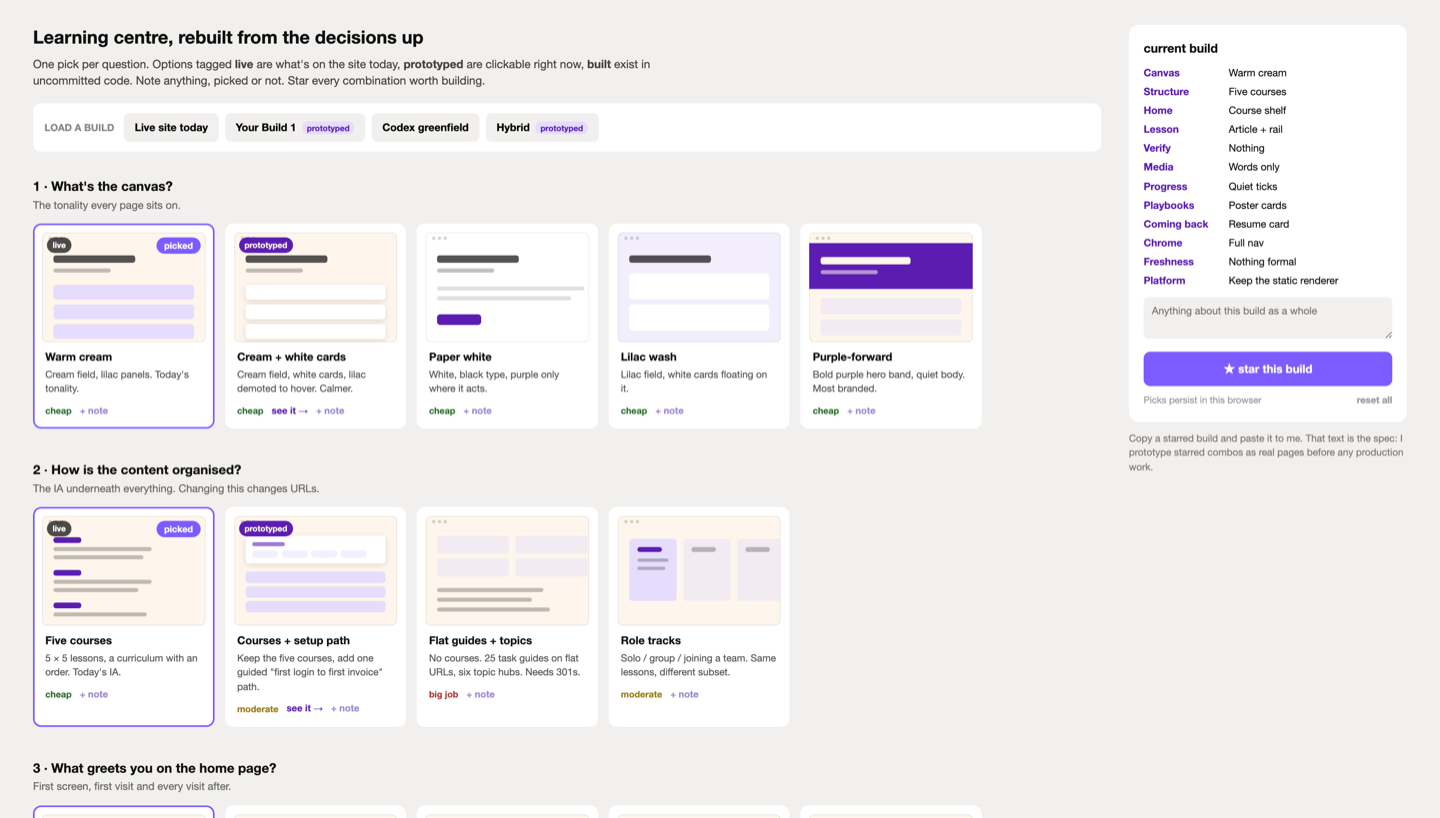
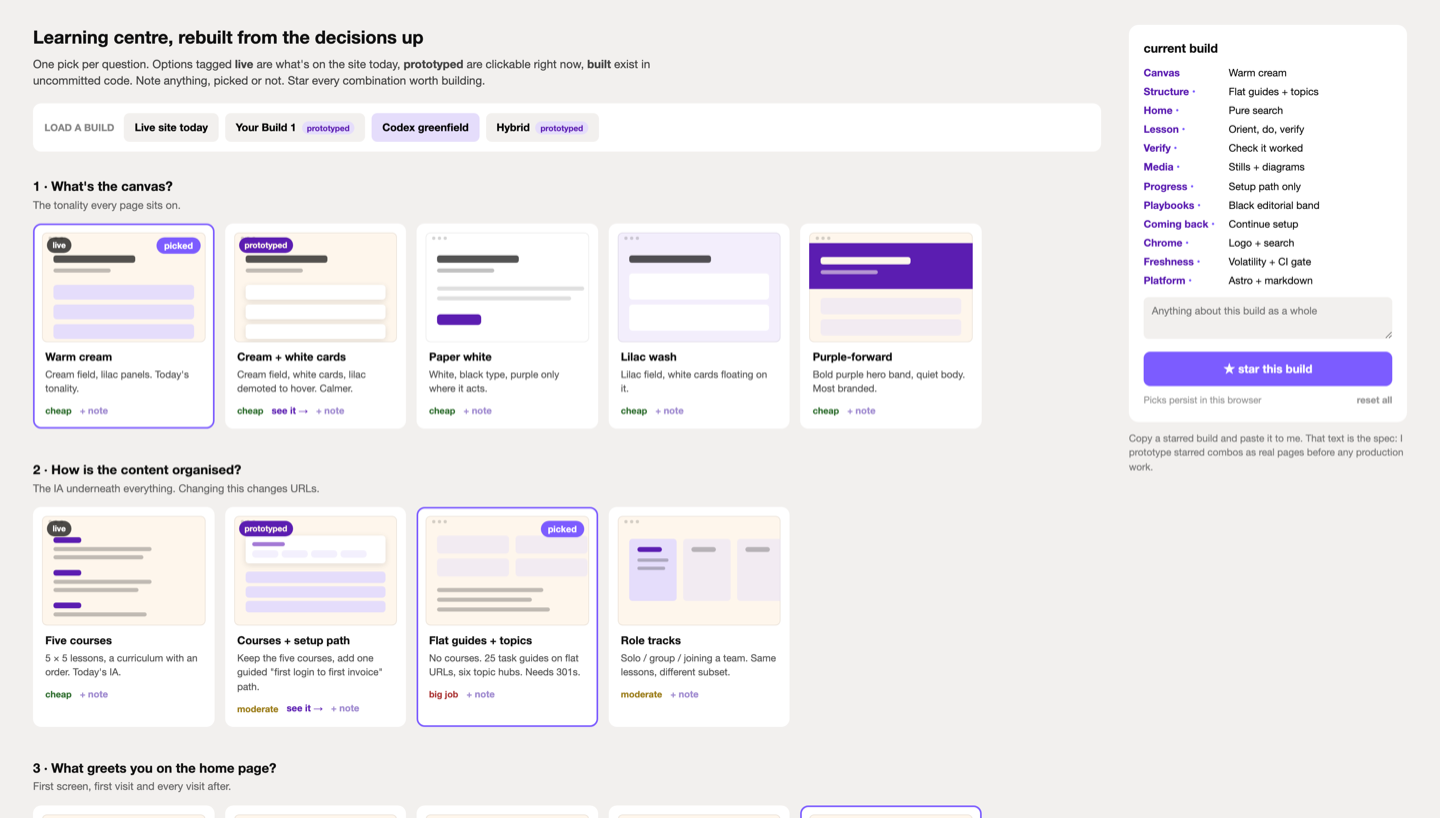
Instead of guessing again, we built a design picker: 12 questions, 51 options, each with a mini mockup, plus three complete build specs to compare. A second, independent take (from Codex) reframed the whole thing: these are task guides, not lessons, so verify by "check it worked", not by exams.

Design picker
The picker · every option is a visual choice · scroll for all 12 questions
Codex counter-proposal loaded in the sidebar
The independent counter-proposal, loaded for comparison

The open question it surfaced: quizzes or task verification? The build on the next slide answers with both, each doing a different job.

learn.carepatron.com · 3 of 3 · learn-academy.carlosmccoy.xyz

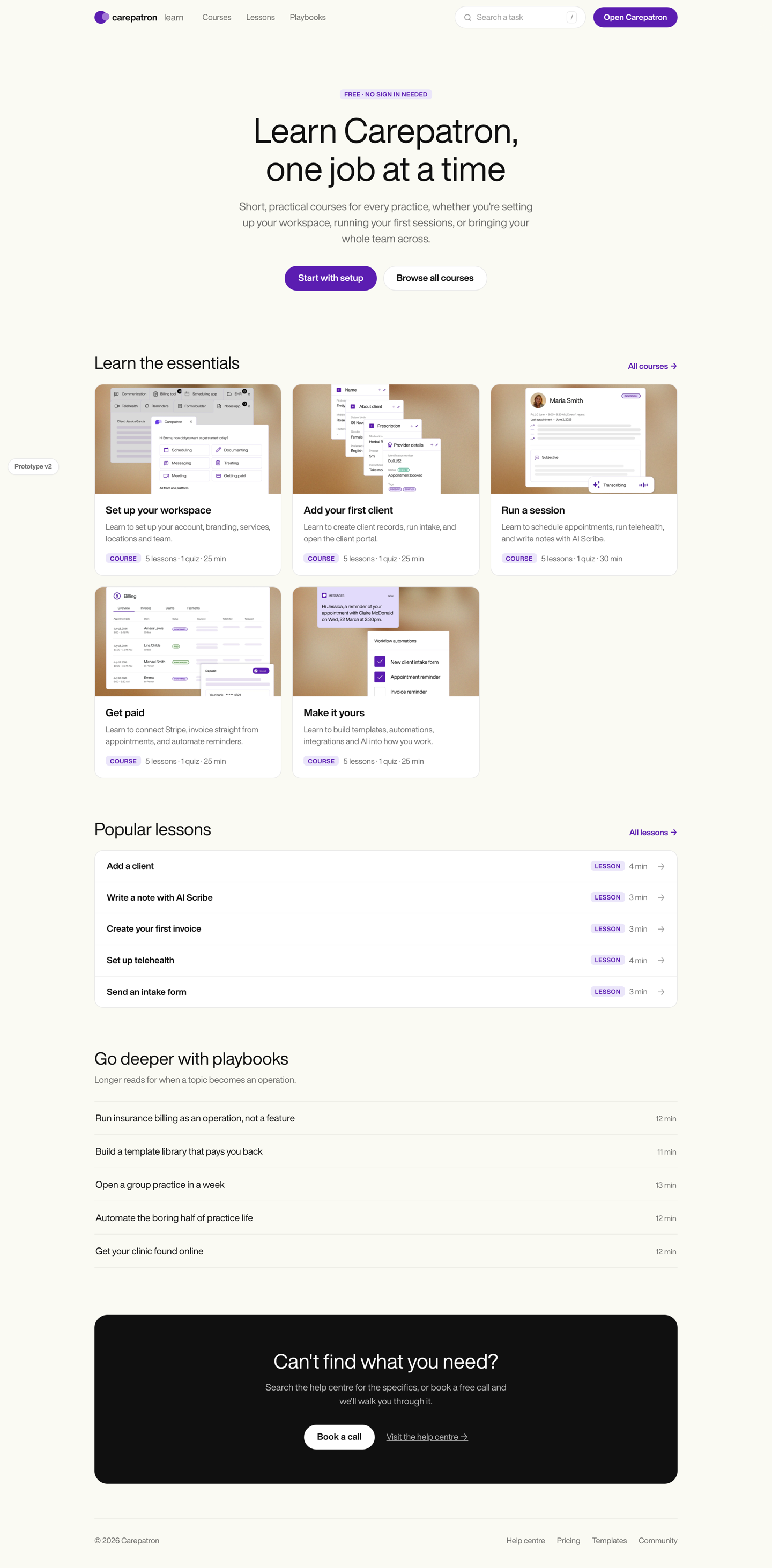
The academy build: learn Carepatron, one job at a time

Academy prototype home
Home · real product imagery, search as primary nav
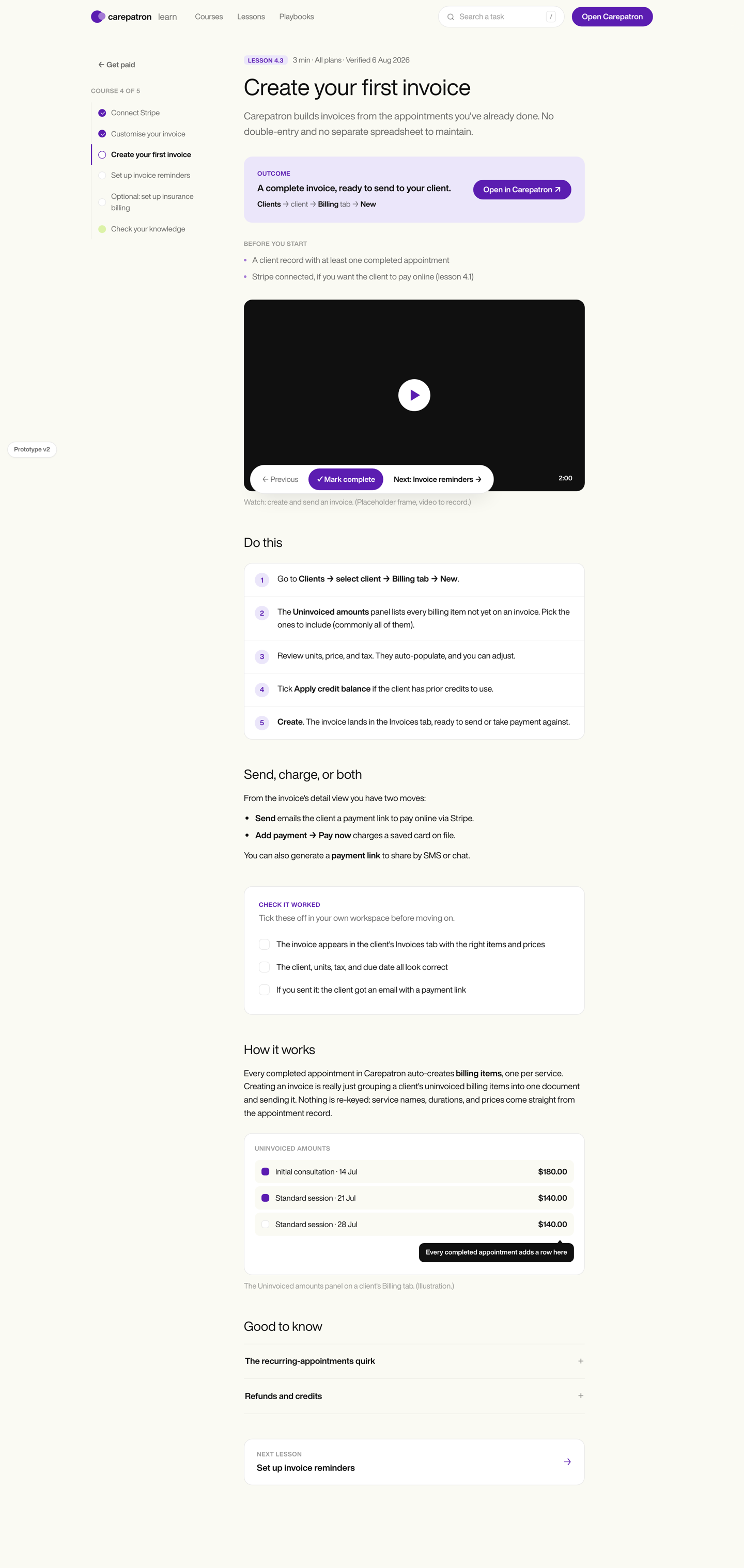
Academy prototype lesson
Lesson · outcome first, numbered steps, "check it worked"
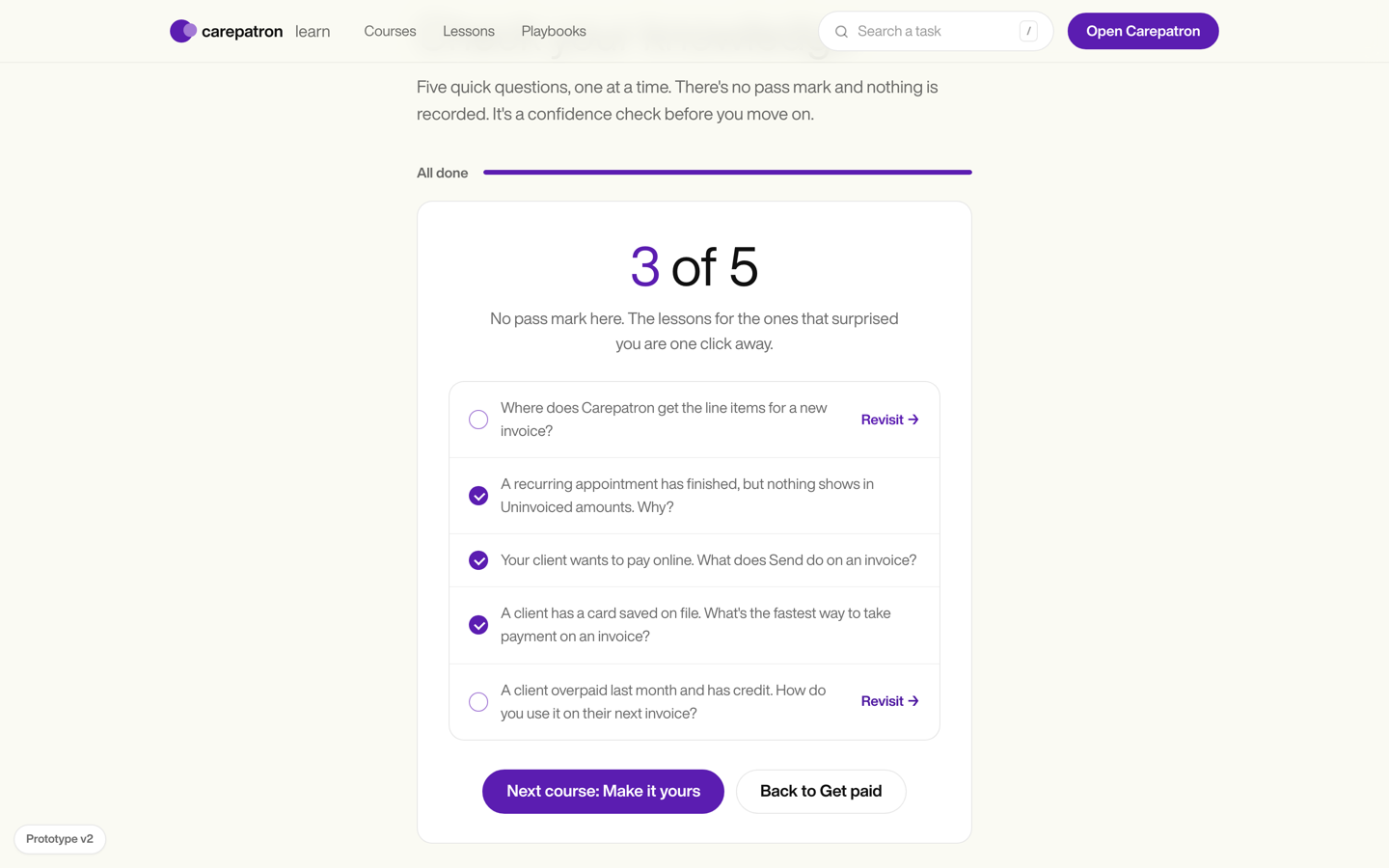
Academy prototype quiz result
Course quiz · no pass mark, revisit links on misses

Four full pages, built from the live carepatron.com design tokens rather than a style guide. Lessons are task-shaped: what you'll get, do this, check it worked, then the explanation. A calm five-question quiz closes each course.

Status: clickable prototype, direction under review. Shipping goes through eng's normal ticket and staging path.

Signup · 1 of 3 · npi-signup.carlosmccoy.xyz

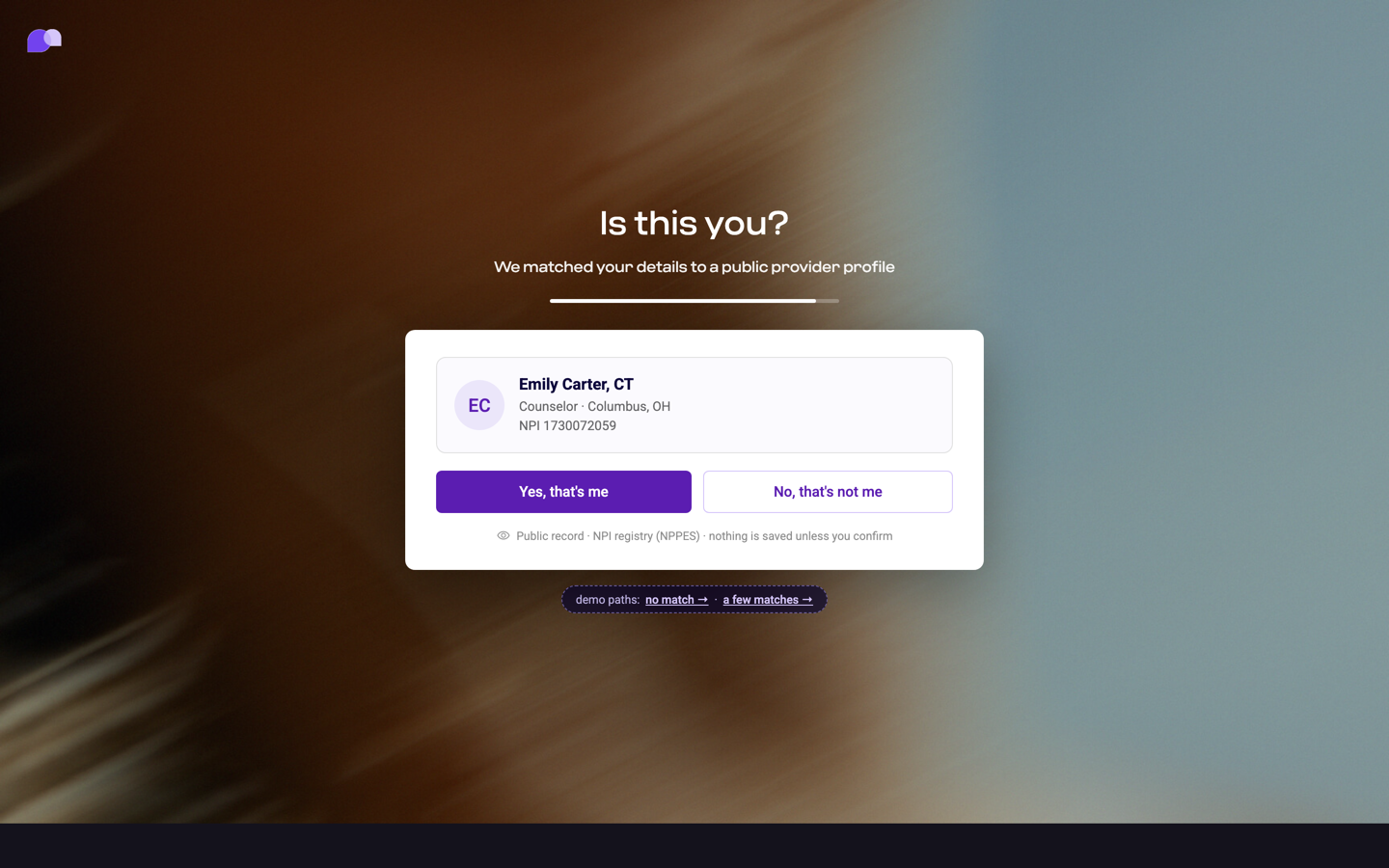
NPI lookup in signup, with zero new fields

Use what signup already collects

Prototype v5

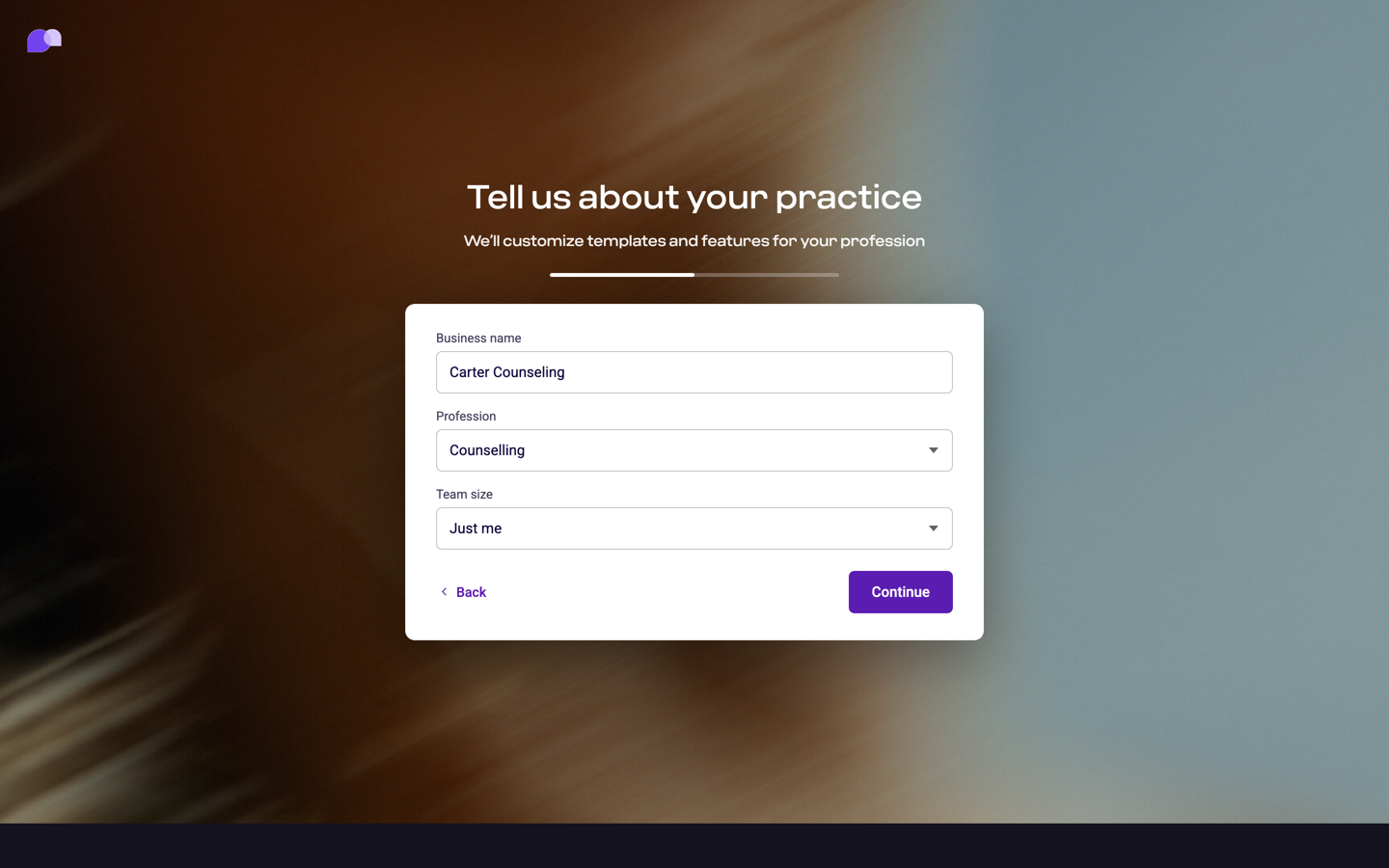
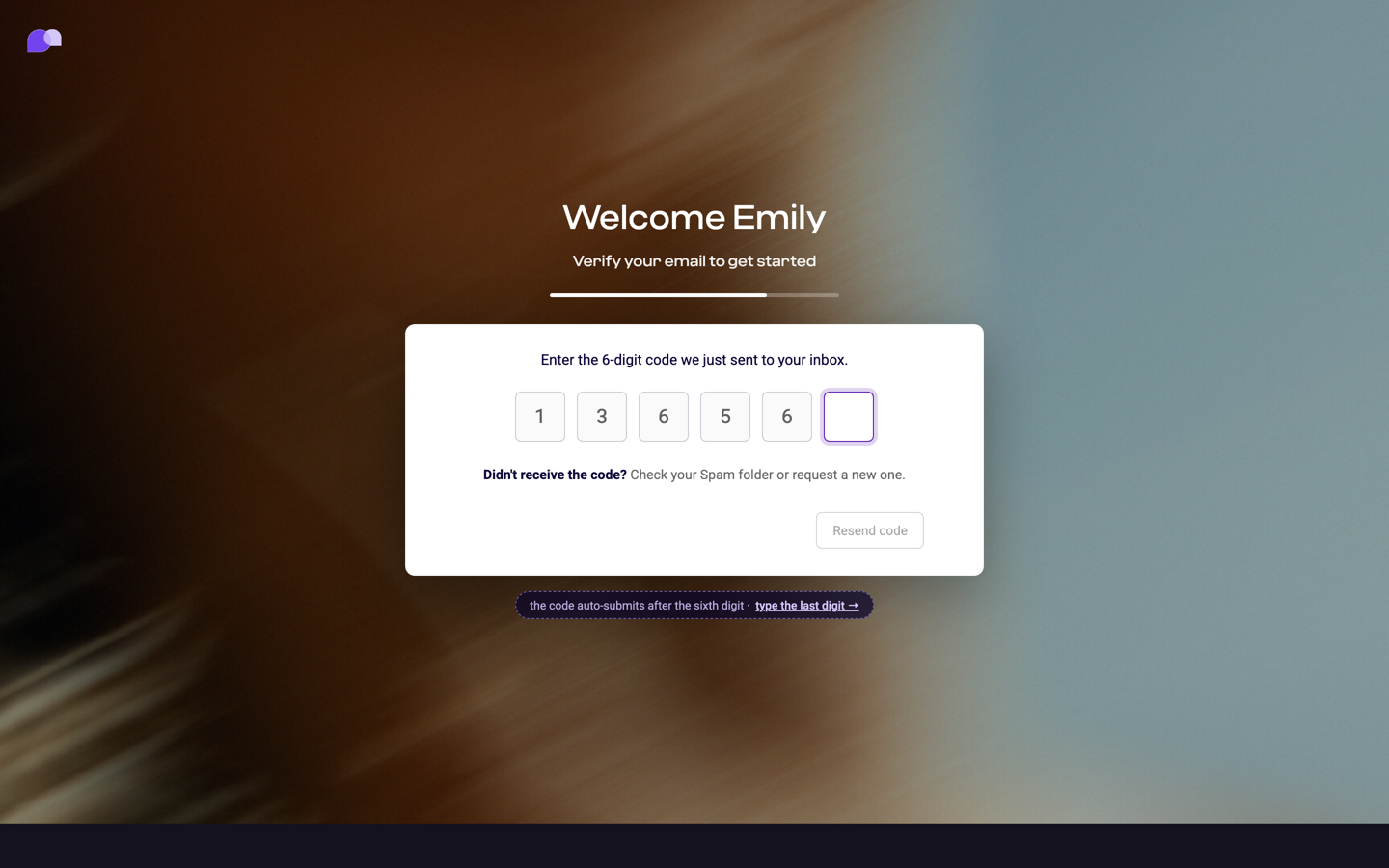
Name, profession and practice name are already asked. IP gives the state. While the person waits for their email code, those details query the free federal NPI registry in the background. No new fields, no added wait.

It never gates signup

No match, too many matches, "not me", non-US: every one of those falls through silently to today's exact flow. The idea came from David; five feedback rounds with David, Dylan and Nanz got it to v5.

Built pixel-close to production

The prototype recreates the real signup screen for screen, from a production capture, so what you click is what we would ship.

Practice details step
Existing step: practice and profession
Email verification step
The lookup runs during this wait
Signup · 2 of 3

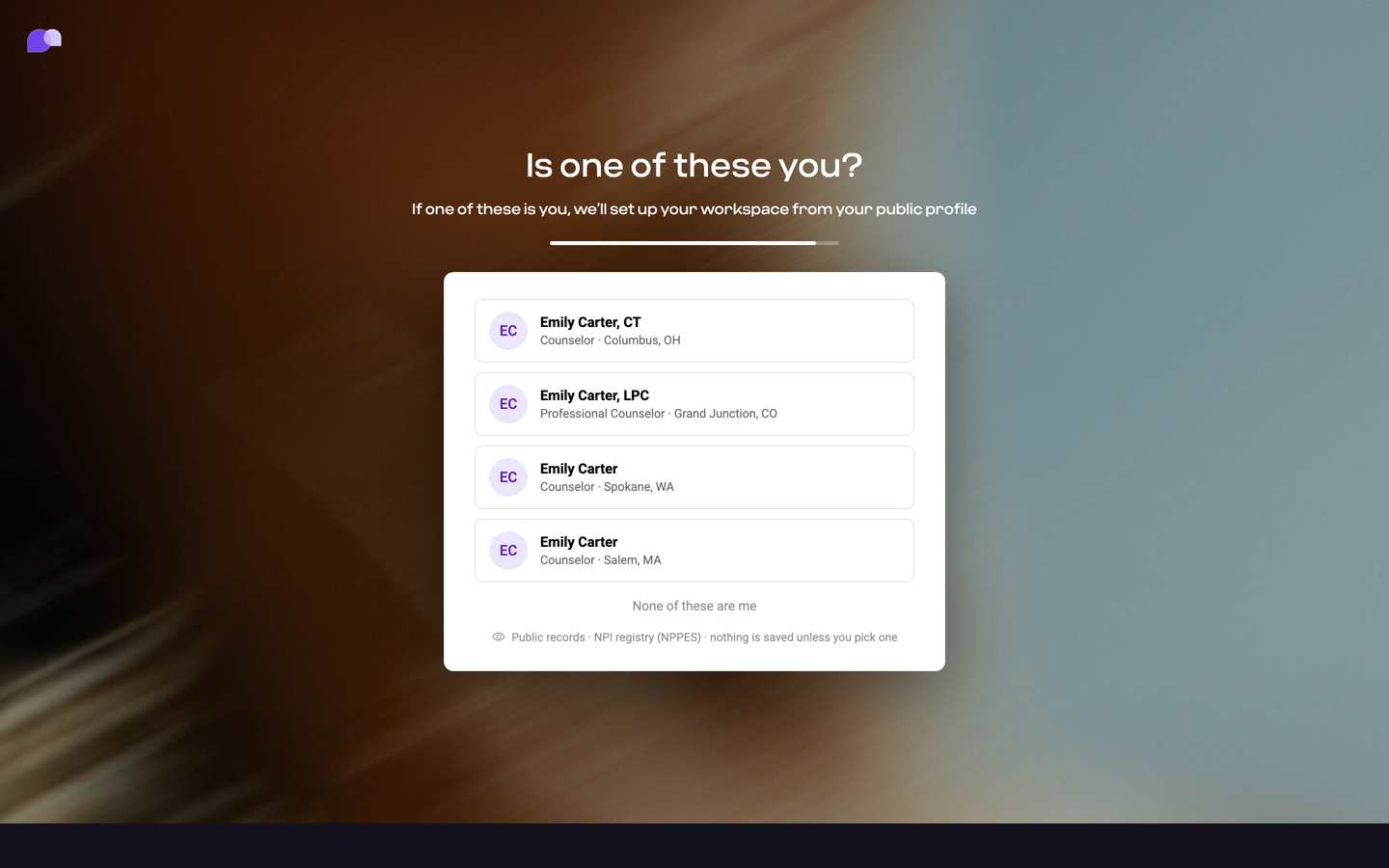
One question, only when we are sure

Single match confirm card
Exactly one match: a yes or no card, nothing else
Multi match picker
2 to 4 matches: a short picker, hard-capped

We measured why profession is the key. Name alone returns 200+ registry records for a John Smith. Name plus state is still 17. Name, state and profession collapse it to 0 to 4. At zero or five-plus we show nothing at all.

One constraint found early: the registry API blocks browser calls, so the lookup goes through our backend, where the verification call already lives.

Signup · 3 of 3

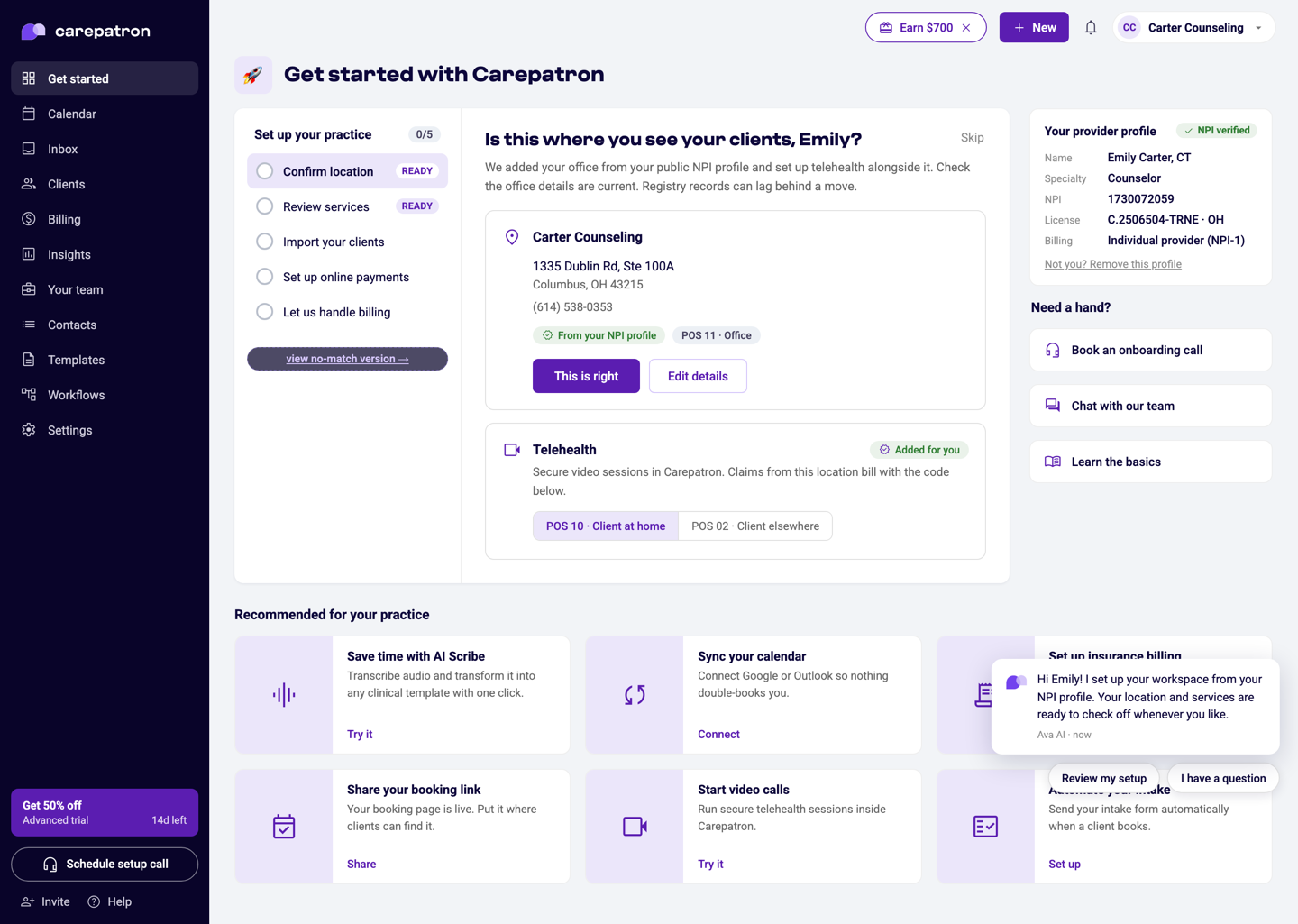
Confirming seeds the whole workspace

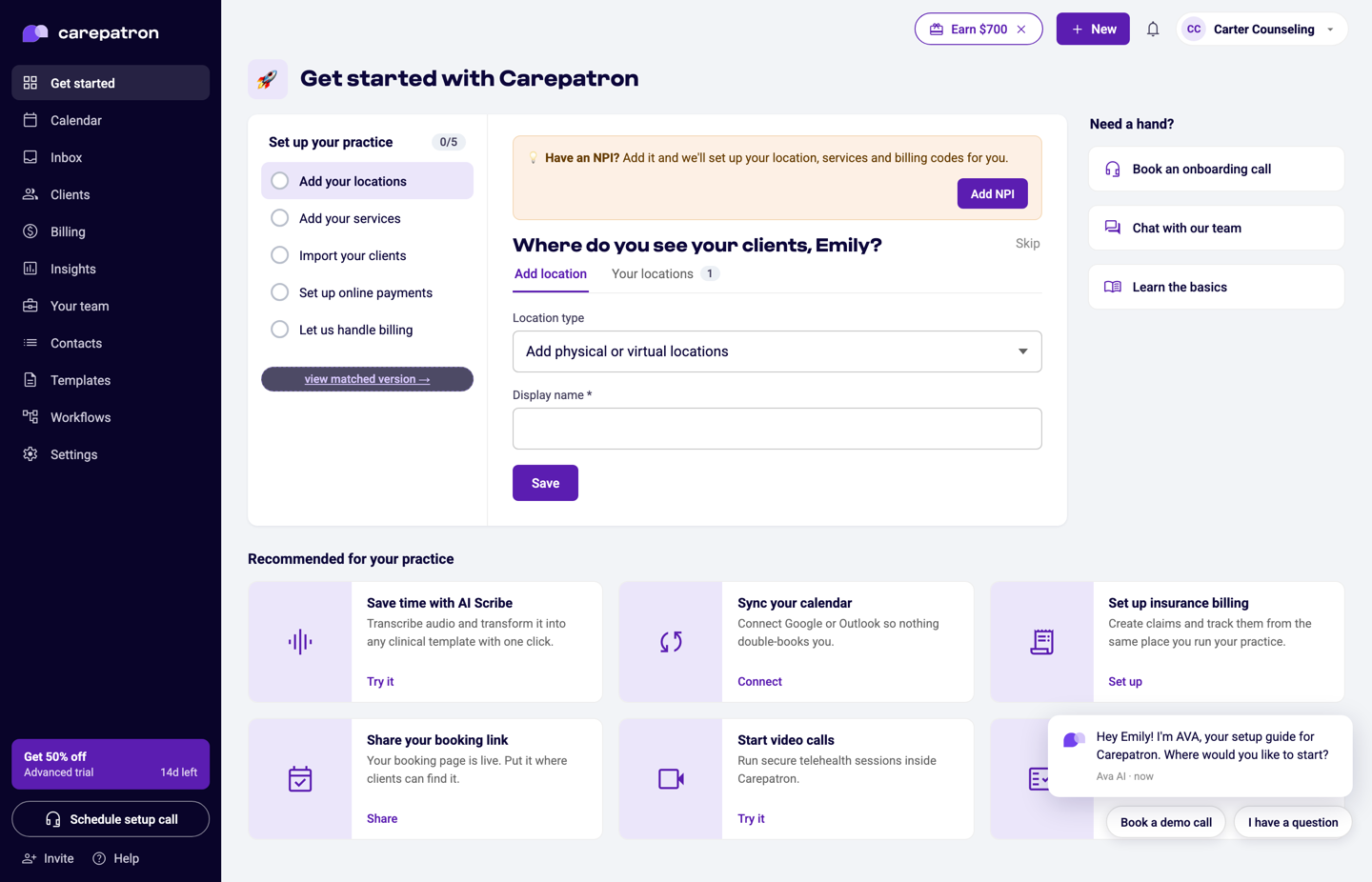
No match: today's dashboard with NPI banner
No match: today's dashboard, plus one banner
Matched: location prefilled
Matched: location confirmed, not typed
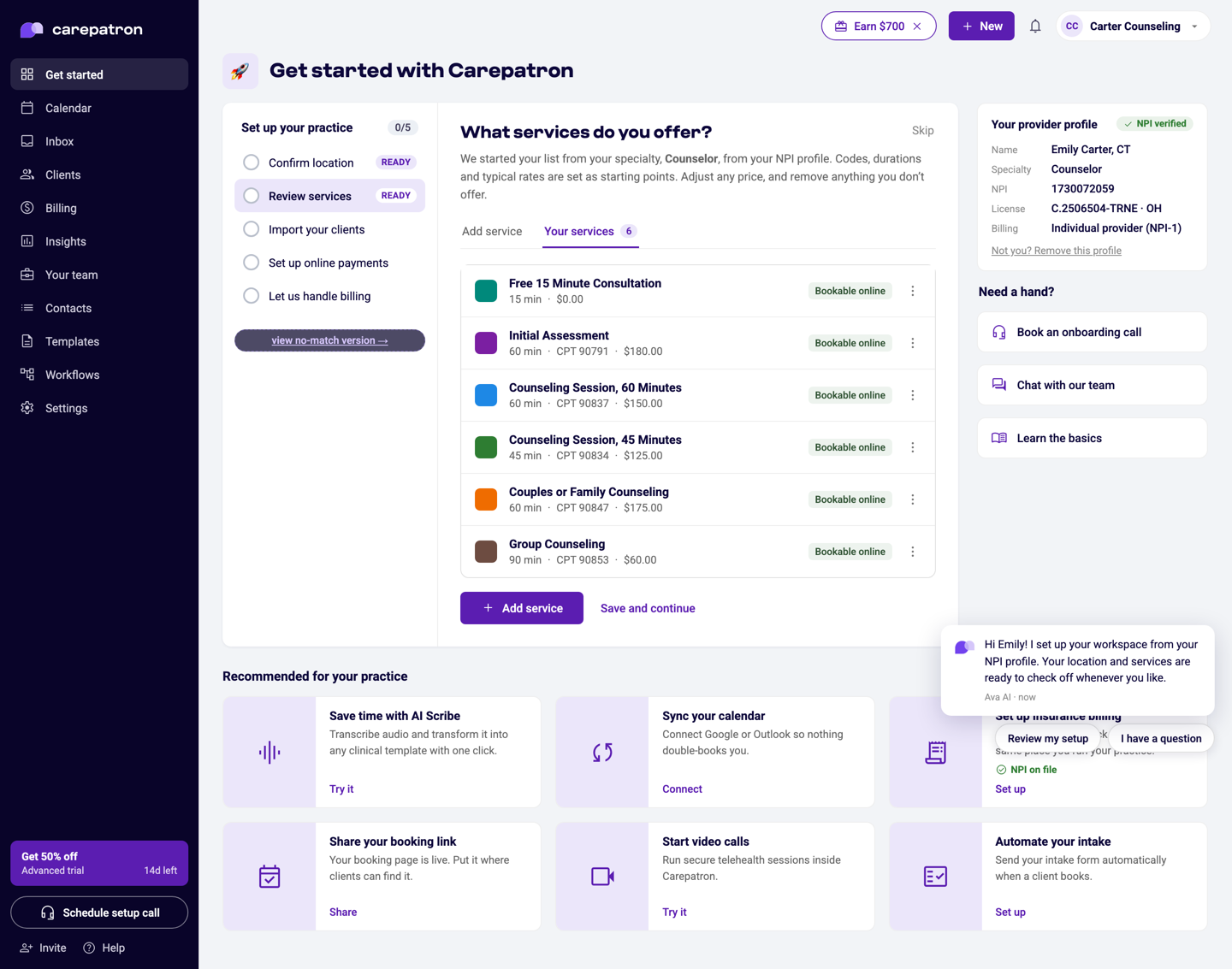
Matched: services seeded with codes and prices

A confirmed NPI prefills location, seeds services from the v5 catalogue, and hands RCM onboarding a billing status it can trust: the Managed Billing checklist arrives with 4 of 7 steps done. David's sizing, an estimate: roughly 1,000 NPI-verified workspaces a month if half of US signups match.

We also answered the seeding question with data: routing services by registry taxonomy instead of the signup profession changes the list for only 0.3 to 2.2% of matched signups, so a small lookup table ships in v1 and specialty lists can wait. Plan: profession-seeded services first (Leah can start now), then the lookup behind a 20% US rollout with tracking already specced.

Default services · v5 review site

108 starting services, repriced against real market data

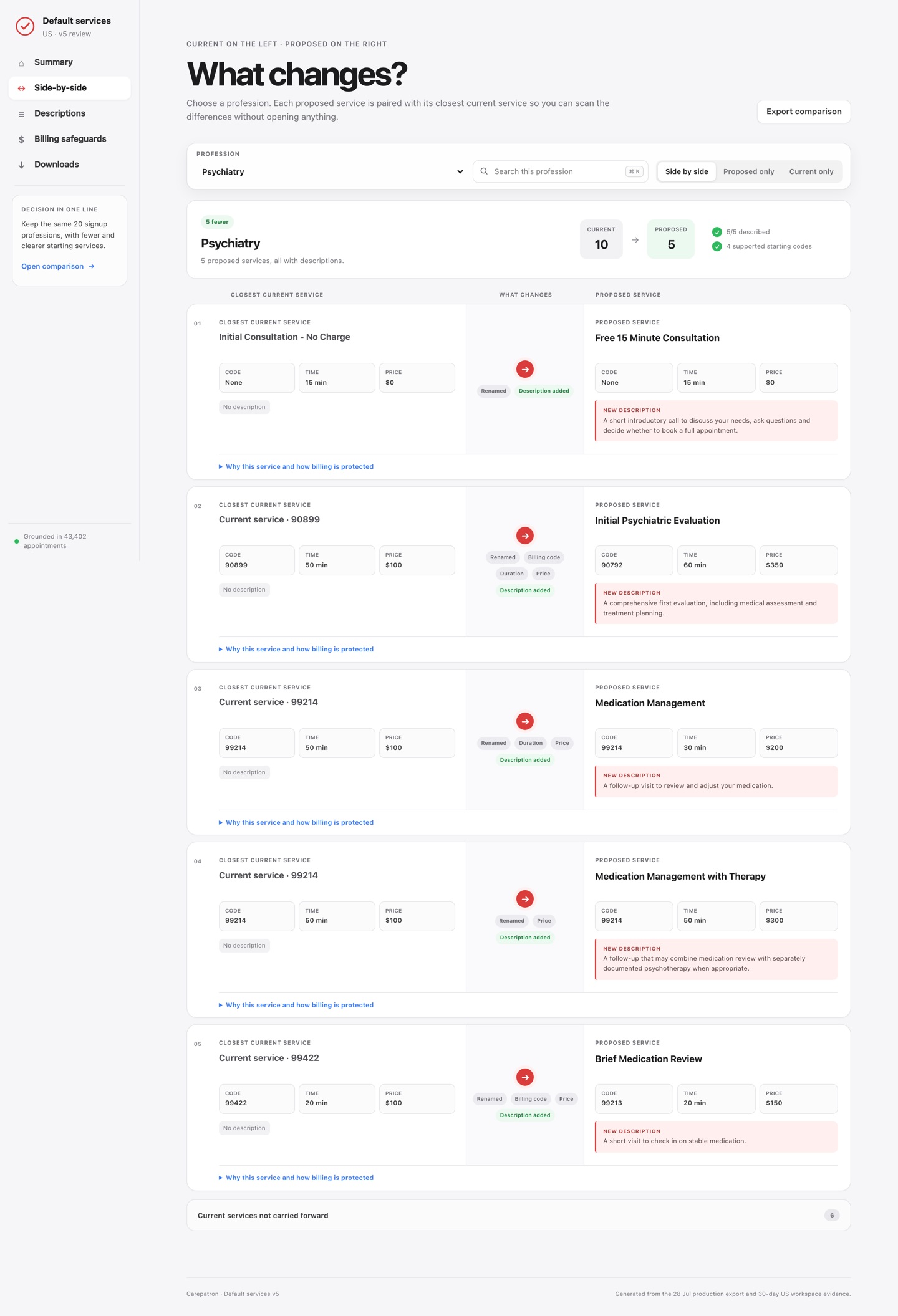
Today, 103 of the 144 services a new workspace gets sit at exactly 50 minutes and $100. The v5 catalogue fixes that: 108 services across 20 professions, every one described. Monday's pass revised 55 prices (32 down, 23 up) and left the structure untouched.

ExampleBeforeAfter
Nursing · New Patient Visitwas carrying nurse-practitioner rates$175$100
Psychiatry · Initial Evaluation$400$350
Chiropractic · New Patient Exam$120$150
OT · Evaluation$175$200

Rule that held: a price changes only on three independent US sources, and the strongest was a 3,000-therapist income report. Every price is an editable cash starting point, never a claim charge. Descriptions for 52 services were tightened in the same pass. Shipping into product sits with Kim's ticket.

v5 review site: psychiatry side-by-side comparison
The review site: every change side by side, live for David · scroll for all five psychiatry rows
Pricing · the October cliff

9 of 40 said yes. Nobody has said no.

Three touches tripled acceptance

Live

The 50%-off-annual offer went to 40 legacy Advanced accounts. Email alone: 3 acceptances. A plain reminder: 5. An in-app message: 9, which is 22.5% of the pilot. Every survey response is a yes, re-verified in PostHog this morning. Reach was the constraint, not the offer.

The real population is 27x the pilot

The full October cliff: 1,109 legacy Advanced monthly accounts, roughly 2,600 seats (estimate from a 200-account sample). The pilot skewed to larger accounts, so its rate may not transfer cleanly. The other 1,069 accounts have had zero communication so far.

What it needs now

The 9 accepted offers need manual plan application, and the full-cohort rollout needs a design before September. The only declines anywhere: 5 people swatted away the in-app with "Not now", which is a softer signal than a survey no (still zero of those).

Next week

Where this goes

Decisions due

  • Learning Centre: settle the direction, then a ticket into eng's normal ship path
  • NPI in signup: walk Leah through it; part one (profession-seeded services) can start now
  • Price increase: apply the 9 accepted offers, design the 1,109-account rollout before September

Keep the machines fed

  • RFP Radar: portal registrations (about 90 minutes) and Glen's pass over the claim library
  • Default services: David's review, then the ship ticket with Kim
That's the week

Two systems live, two prototypes a verdict away

The radar hunts every morning, the pilot keeps converting, and the signup and learning flows are ready to click, not just to discuss.

Thanks, team.